Monitored security telemetry
Relevant logs and signals are brought into the monitoring scope based on the agreed architecture and risk priorities.
- Endpoints and servers
- Network and security devices
- Cloud, identity and key applications

SecureLink’s Managed SOC Services in Saudi Arabia provide continuous monitoring, analyst-led alert triage, evidence-based investigation, severity-driven escalation and operational reporting. The service is built for organizations that need dependable visibility across endpoints, identity, networks, cloud platforms and critical applications without staffing every monitoring shift internally.
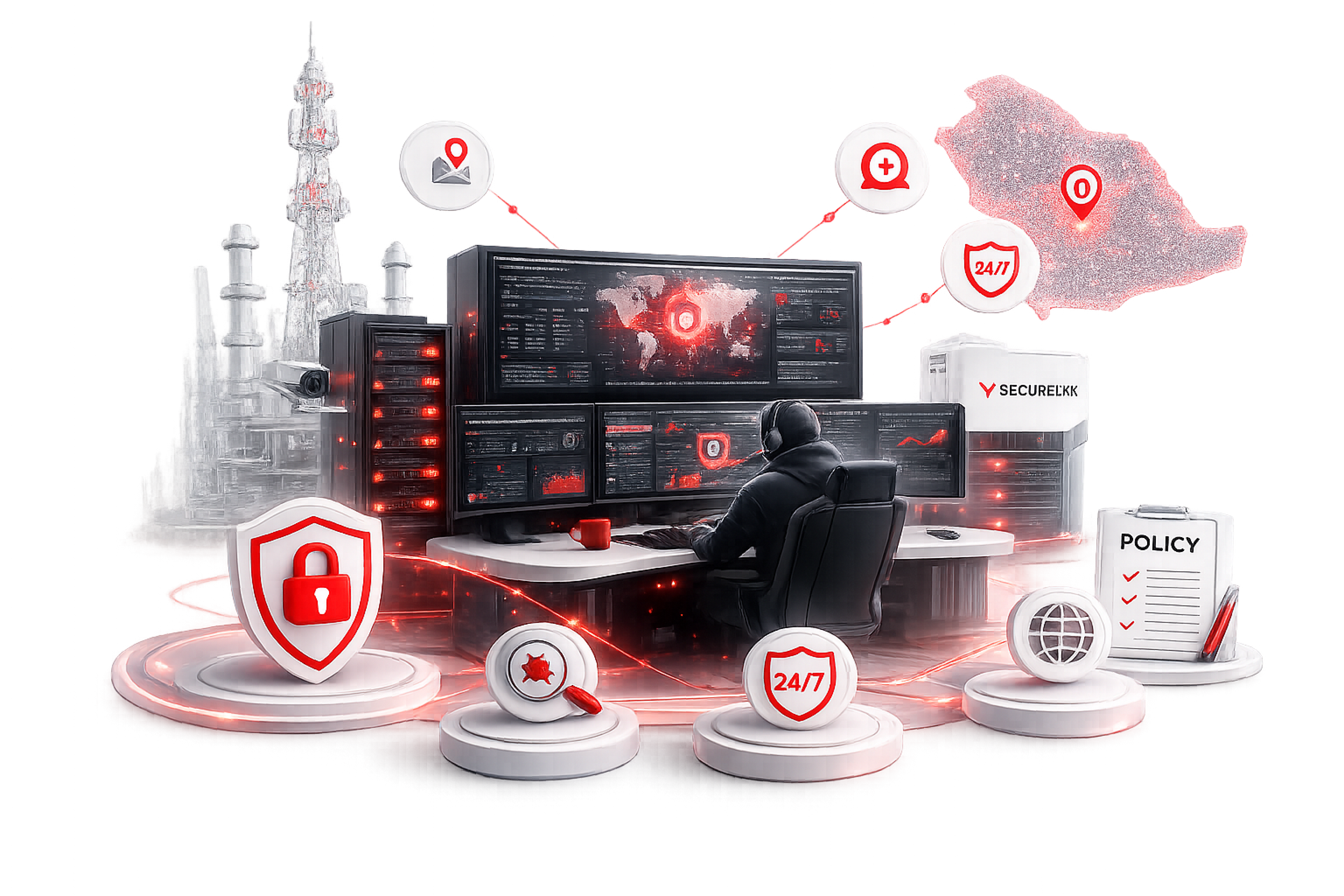
Monitor the approved telemetry continuously and route material alerts into an analyst-led investigation workflow.
Validate suspicious activity, establish context and coordinate approved containment actions through documented playbooks.
Maintain data-source health, correlate events, tune detections and preserve investigation evidence for operational review.
Provide traceable case records, trend reporting, service metrics and evidence that can support governance teams.

SecureLink operates a Security Operations Center Saudi Arabia service model for organizations that need dependable analyst coverage, documented escalation and a repeatable process for handling security events.
The operating model brings together analysts, case procedures and security technology to collect approved telemetry, correlate events, investigate suspicious activity and coordinate response with internal stakeholders. Coverage can include on-premises, cloud and hybrid environments when the required signals, permissions and business context are available.
Unlike a one-time assessment, SOC as a Service Saudi Arabia is an ongoing operational capability. Analysts review alerts, add asset and identity context, reduce recurring noise, document conclusions and escalate confirmed risks through agreed severity and communication rules.
The service also covers SIEM data-source health, detection tuning, case reporting and practical recommendations that help security and business owners understand recurring attack patterns, monitoring gaps and overdue response actions.
SecureLink provides a central operating model for monitoring security events, investigating suspicious activity and coordinating response actions. The service combines security telemetry, analyst judgement, documented playbooks and customer context across the systems included in the approved scope.
Monitoring begins only after responsibilities, data sources, severity rules, authorized actions and escalation contacts are agreed. SecureLink investigates and coordinates the case; the customer retains authority for production changes, business decisions and formal risk acceptance unless the contract states otherwise.
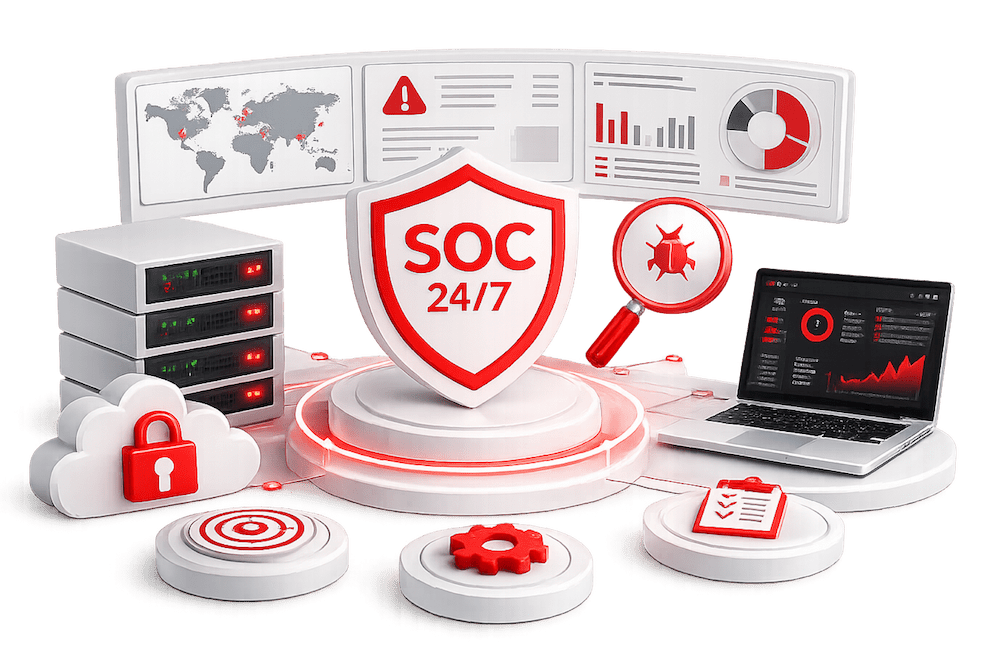
Security events do not follow office hours, and high-volume tools can overwhelm internal teams with alerts that lack business context. SecureLink provides a defined monitoring and investigation workflow that filters noise, preserves evidence, coordinates action and gives internal owners a clear record of each material case.
A strong SOC service should produce more than alert notifications. SecureLink structures the service around actionable investigation, traceable decisions and reporting that helps technical teams and business leaders understand what happened and what to do next.
Relevant logs and signals are brought into the monitoring scope based on the agreed architecture and risk priorities.
Alerts are reviewed for context, severity and business relevance before escalation, reducing noise for internal teams.
Investigation records explain the observed activity, affected assets, evidence considered and analyst conclusion.
Confirmed incidents are escalated through the agreed matrix so system owners and decision-makers can act quickly.
Operational and management reporting helps teams track alerts, incidents, trends and recurring control gaps.
Use cases, data sources and escalation rules can be refined as the environment and threat profile change.
The SOC scope is built around telemetry coverage, detection quality, investigation depth, escalation rules and the actions each party is authorised to perform.
A useful SOC does not simply forward alerts. It records evidence, explains severity, identifies the responsible owner and tracks each material case to an agreed outcome.
Analysts monitor the approved data sources continuously, validate material alerts and escalate events according to the agreed severity matrix.
SIEM operations include log-source onboarding, data-health checks, correlation, retention oversight, use-case tuning and support for investigation workflows.
SecureLink uses approved threat-intelligence sources and environment context to enrich investigations and help analysts prioritise activity that may affect Saudi organizations.
Our SOC team investigates alerts, coordinates approved containment actions, supports root-cause analysis and provides clear remediation recommendations.
Reports distinguish alerts from confirmed incidents, show recurring trends, record service performance and identify unresolved control or remediation actions.
Monitoring can include endpoints, servers, network controls, identity services, cloud platforms and critical applications. Inclusion depends on integration support, signal quality, licensing and the approved scope.
The service can be structured around your existing people, technology and operating hours. During scoping, SecureLink defines which activities are managed by the SOC, which decisions remain with your internal team and how incidents move between both sides.
SecureLink operates the day-to-day monitoring, triage, investigation, escalation and reporting workflow for the agreed environment.
SecureLink works alongside your security team, extending analyst capacity while preserving internal ownership of selected tools, investigations or response actions.
Extend coverage outside normal business hours or during periods of high alert volume without replacing the existing internal security function.
Managed SIEM Services KSA coverage can include platform administration, data-source health, detection tuning and investigation workflows as one component of the wider SOC operating model.
Onboarding is designed to make monitoring useful from the start. The exact sequence depends on your environment, but the service follows a controlled process that defines scope, connects data, validates detections and confirms response responsibilities.
Identify critical assets, business services, existing controls, key contacts and the outcomes expected from the SOC.
Prioritise log sources and integrations based on risk, operational value, technical feasibility and agreed retention needs.
Define detection priorities, severity levels, alert-routing rules and the evidence required for investigation.
Agree who is contacted, what information is provided and which actions require customer authorisation.
Test data flow, alert creation, notification paths and reporting before moving into normal operations.
Refine use cases, reduce unnecessary noise and extend coverage as systems, risks and business priorities change.
A consistent case workflow helps analysts move beyond raw alerts. Each stage adds context, records decisions and gives internal stakeholders the information needed to respond appropriately.
Confirm whether the alert is meaningful by reviewing the triggering activity, affected asset, user context and supporting telemetry.
Build a timeline, identify related activity, estimate the potential scope and determine whether the event is benign, suspicious or confirmed.
Assign severity using technical evidence, business criticality, exposure and the potential operational or data impact.
Notify the agreed contacts with clear findings, recommended actions and any decisions or approvals required from the customer.
Document the outcome, preserve the case record and identify tuning, control or process improvements. Technical remediation identified through SOC cases can be delivered through IT Security Services in Saudi Arabia.
Cybersecurity Monitoring Services Saudi Arabia coverage is useful only when connected telemetry supports relevant detection and investigation. SecureLink prioritises use cases around critical assets, credible attack paths, business exposure and available evidence rather than generating alerts without context.
Suspicious sign-ins, repeated authentication failures, unusual locations, dormant-account activity and unexpected privilege changes.
Potential malicious execution, unusual file changes, security-tool alerts, command activity and behaviours associated with encryption or lateral movement.
Unexpected processes, persistence attempts, suspicious scripts, disabled controls, abnormal administrator actions and changes on critical systems.
Scanning, unusual connection patterns, blocked or allowed malicious traffic, unexpected outbound communication and changes to network-security devices.
Risky administrative changes, exposed services, unusual access, policy modifications and suspicious activity within connected cloud platforms.
Suspicious messages, malicious links or attachments, account compromise indicators and unusual mailbox or forwarding-rule activity where telemetry is available.
Use of high-risk accounts, creation of new administrators, security-policy changes and actions that require additional verification or approval.
Large or unusual transfers, access to sensitive repositories, abnormal download patterns and other indicators that warrant investigation.
The exact sources depend on architecture, licensing, integration support and the approved monitoring scope.
Scope principle: connecting every available log source is not always the best first step. Priority should be given to critical assets and high-value security signals, followed by phased expansion and detection tuning.
A Managed SOC can provide security evidence, incident records and continuous monitoring outputs that support a wider governance and compliance programme. It does not certify compliance, replace a formal assessment or remove the organization’s accountability. Framework ownership, risk treatment and evidence coordination remain part of the relevant GRC Services workstream.
The value of a managed SOC depends on investigation discipline, usable telemetry, clear escalation rules and accountable service reviews—not on alert volume alone.
A structured monitoring, investigation, escalation and reporting model aligned to the agreed service scope.
Scope discussions consider local operating requirements, stakeholder access, reporting expectations and agreed handling of monitored security data.
Each escalated case records the observed activity, evidence considered, affected assets, severity rationale and recommended next action.
Coverage, data sources and operating responsibilities can be expanded as your environment and internal security capability evolve.
Detection tuning, investigation context and recurring service reviews help teams address risks before they become larger operational problems.
Track telemetry health, case activity, escalation performance, unresolved actions and detection-coverage changes within the approved scope.
Managed monitoring works best when investigation and response responsibilities are agreed in advance. SecureLink operates the defined SOC workflow, while the customer retains authority over business systems, users, production changes and risk acceptance.
The monitoring model is adapted to the organization’s critical systems, operating hours, data sources, escalation authority and sector-specific incident priorities. Sector labels alone do not determine the SOC scope.

Empower your business with industry-specific cybersecurity solutions that enhance resilience, safeguard critical assets, and support compliance with evolving security requirements across Saudi Arabia.
SecureLink can establish a structured monitoring, investigation, escalation and reporting model around your environment. The scoping discussion covers critical assets, telemetry priorities, integration constraints, authorized actions, service levels and the responsibilities retained by your internal team.
Review practical questions about telemetry onboarding, severity, authorization, investigation quality, service ownership and SOC performance.