
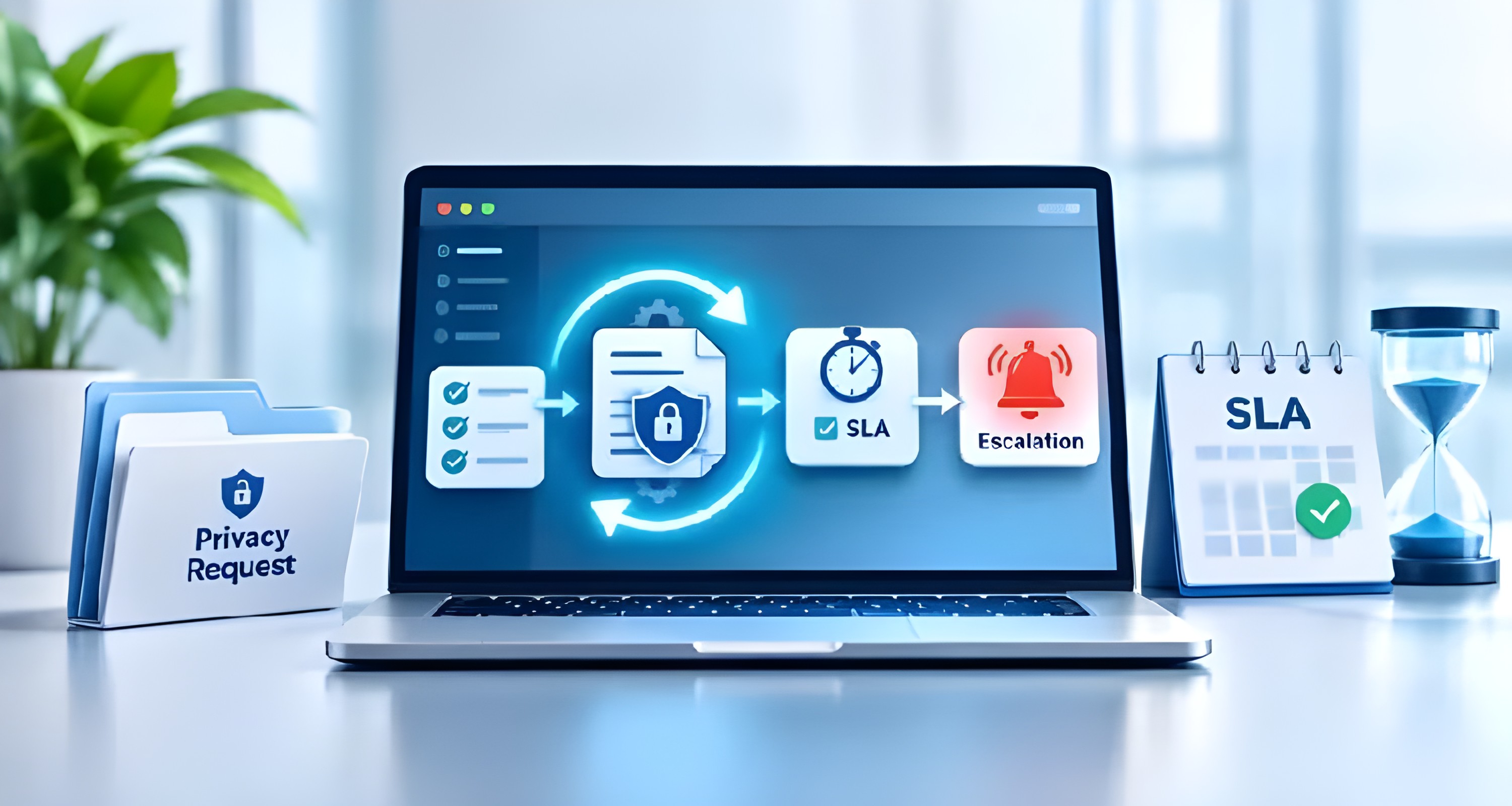
Managing privacy requests efficiently is essential for businesses handling personal information and sensitive customer data. With rising request volumes tracking using manual means may result in missed deadlines, slow responses and compliance issues. The Privacy Request Escalation Automation assists organisations to create formal procedures, allocate roles and make sure that requests are responded to in a timely manner by pre set service level agreements (SLAs).
With Privacy Compliance Automation businesses are able to enhance response management, enhance accountability and minimize operation gaps. SecureLink assists organisations to create and maintain trusted privacy workflows to aid in a consistent request handling and compliance goals with the right approach.
What Is an SLA-Based Privacy Request Escalation Workflow?
An SLA-based privacy request escalation workflow is a stepwise process that specifies response times, duties and escalation steps of dealing with privacy-based requests. It also makes sure that all the requests are addressed accordingly within the set timelines.
In case of time constraints or in cases where schedules are met or missed, an automated policy reminds the responsible employees or escalates pending cases to the assigned managers. This enhances transparency, promotes accountability and assists organisations to have a steady state of request management.
Why Do Businesses Need a Structured Privacy Request Escalation Process?
1. Managing Increasing Privacy Request Volumes
Privacy requests that businesses are provided with are access to data, correction, deletion and processing limitations. Handling such requests becomes hard to manage when the numbers increase and a structured workflow would be vital in terms of efficient management.
2. Preventing Missed Deadlines and Delayed Responses
The requests of privacy are usually accompanied by certain periods of regulations response. The employees can miss crucial deadlines without adequate monitoring. There are automated reminders and escalation notifications that assist the teams in prioritising the pending requests and avoid unnecessary delays.
3. Improving Accountability Across Departments
Legal, compliance, IT and customer service teams are often needed to collaborate on privacy requests. Clear responsibilities make sense because they create clear ownership, and automated assignments provide the employees with an idea of what they have to do and the managers with an idea of what to do.
4. Maintaining Consistent Privacy Request Handling
Standardised workflows make sure that similar requests have the same procedure within the different departments. Organisations may use established verification procedures, approval criteria, response templates and escalation clauses and minimize unstable decisions and enhance the overall quality of service.
How to Automate Privacy Request Escalations Using SLA-Based Workflows
1 . Categorize Privacy Requests by Type and Priority
Begin by categorizing incoming requests into data access, correction, deletion and consent withdrawal. Privacy Request Escalation Automation can be enhanced by workflows that are aware of the urgency of the request and that it is given a suitable handling priority.
2. Define SLA Timelines and Internal Response Targets
Create specific timelines on how to recognize, review, process and fulfil privacy requests. Establish internal response dates that are smaller than available regulatory dates to provide teams the time needed to research problems and find solutions to unforeseen problems
3. Automate Privacy Request Assignment and Routing
Automatically allocate requests based on their category, complexity and department of responsibility through configuring workflow rules. Assign cases to respective employees and eliminate manual coordination and make sure that all the requests end up in the right team.
4. Configure Automated Deadline Alerts and Notifications
Establish automated reminders to deadlines, approvals and tasks which are outstanding. Send reminders to employees and supervisors who are expected to be responsible at specific time intervals and make sure to remind outstanding requests before response due dates are critical.
5. Establish Automated Escalation Rules
Enact Privacy Request Escalation Automation a set of rules to initiate predetermined actions in case employees fail to meet internal deadlines or unfulfilled requests. The escalation rules are able to alert the supervisors, engage the compliance officers and reassign the cases where appropriate.
6. Monitor Request Progress Through Centralized Dashboards
Monitor request volumes, completion rates, cases that are overdue and the activities of escalation using centralised dashboards. Privacy Request Escalation Automation enhances the visibility of operations, making it easier to manage the various bottlenecks, the performance of the team and the unresolved requests.
7. Maintain Escalation Records and Audit Trails
Keep a record of request submissions, employees assigned to it, deadline alerts, and escalation overrides and final responses. Proper audit trails can assist organisations in proving accountability, reviewing delays and can be used to prove in case of internal or regulatory audits.
Best Practices for Effective Privacy Request Escalation Automation
1. Establish Clear Request Ownership and Responsibilities
Each privacy request should have an assigned owner and the responsibilities of the departments should be clearly defined. Have back up ownership plans to ensure continuity of the progress in case of the unavailability of the employees or their change of roles or they need more attention.
2. Set Realistic Internal SLA Thresholds
Establish internal deadlines to consider the verification, investigation, approvals and communication needs. Provide time to handle complicated cases and have a reasonable response target to meet regulatory requirements and operational effectiveness.
3. Create Escalation Paths for Different Request Categories
Establish different privacy request processes on simple and complex privacy requests. Data deletion, access controls and corrections can involve various approvals, technical intervention and investigations to achieve successful resolution.
4. Keep Automated Notifications Relevant and Actionable
Make sure that the notifications indicate the request reference, employee in charge, task that needs completion and an applicable deadline. Minimise over-reminding since employees will not be able to focus on the really important escalation messages.
5. Review and Optimize Workflow Rules Regularly
Measure the workflow performance based on completion rates, pending requests and escalation rate and recurrent bottlenecks. Periodic reviews assist organisations to detect unproductive rules, modify in house deadlines as well as enhance request processing processes.
6. Maintain Accurate Request and Escalation Records
Log major workflow events such as assignments, status, approvals, communications and escalation results. Implement proper access control and data retention policies so that there are no issues with sensitive information and the compliance records are reliable.
Common Mistakes to Avoid When Automating Privacy Request Escalations
1 . Using Identical SLA Timelines for Every Request
Imposing the same deadlines on all privacy requests may cause unnecessary pressure. The different categories of requests have different levels of verification as well as technical requirements thus set up appropriate schedules depending on the complexity and relevant requirements.
2. Failing to Define Escalation Ownership
Escalation will not work when no one comprehends what they are supposed to do. Give particular owners, supervisors and backup contacts in order to make sure that those requests that are not dealt with in time are attended to and dealt with accordingly.
3. Configuring Excessive Automated Notifications
Sending regular notifications may overload employees and make significant alerts to be ignored. Create meaningful notification periods, put priority on urgent messages and only remind the responsible stakeholders about the relevant messages.
4. Ignoring Manual Review and Exceptional Cases
Completely automated processes might not be able to cope with complicated orders, cases of identity checks, and the abnormal conditions. Add manual review checkpoints whereby the authorised employees are able to evaluate the exceptions and make the right judgements.
5 . Neglecting Workflow Testing and Performance Reviews
The initiation of workflows without testing may bring about routing errors, wrong deadlines and unproductive escalation triggers. Periodically measure system performance, test notification rules and remedy any operational problems before they can impact compliance.
How SecureLink Supports Privacy Workflow Automation in Saudi Arabia
SecureLink assists organisations to enhance privacy processes by using formal compliance processes, automated task management and centralised monitoring. The businesses have the ability to enhance the assignment of request, accountability, deadline tracking and documented escalation processes in the respective departments.
Helping organisations to ensure that privacy is managed systematically and that the workflow is monitored can help minimise the amount of manual coordination, enhance operational visibility, and bolster their attitude to privacy demands in Saudi Arabia.
Conclusion
Privacy request management needs to be efficient and therefore, more than just recording incoming requests. Companies must have well-defined roles, achievable SLA schedules, auto-communication, and consistent back-up plans. Privacy Request Escalation Automation unites all these aspects, enabling organisations to reduce delays, enhance accountability and ensure uniformity in handling requests across departments.
The use of structured workflows will also reinforce the visibility of compliance and help to improve operations continuously. Having privacy requests looked into regularly, documented and clear escalation routes organisations will be able to handle them more assertively and develop a reliable strategy of ensuring the safety of personal data.