
Essential Steps for Managing Cybersecurity Risks in Financial Institutions
Home – Blogs
Secure Your Digital Assets Today
Protect your business from cyber threats with advanced security solutions, real-time monitoring, and expert support.
-
 How to Detect Hidden Data Security Risks in Business Systems
 -
 Essential Steps for Managing Cybersecurity Risks in Financial Institutions
 -
 What Technologies Are Used in Industrial Safety Monitoring Systems
 -
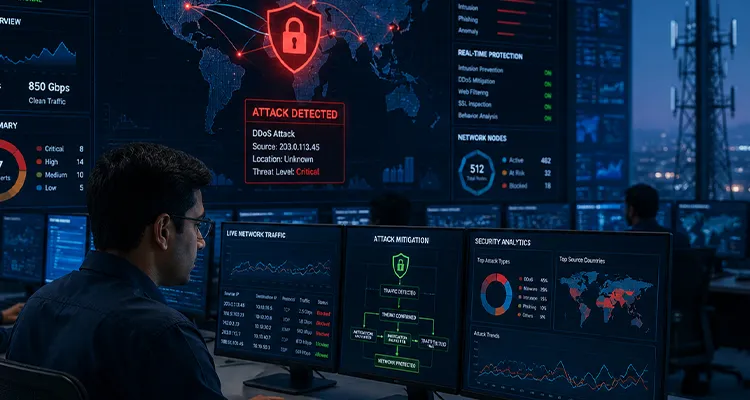 How Telecom Networks Detect and Prevent Cyberattacks in Real Time
 -
 What are the most common cybersecurity risks in government organizations
Essential Steps for Managing Cybersecurity Risks in Financial Institutions
Financial institutions operate in a highly interconnected digital environment where cyber threats continue to evolve in complexity and frequency. Banks, insurance companies, investment firms, and fintech organizations manage vast amounts of sensitive customer and financial data, making them attractive targets for cybercriminals. Managing Cybersecurity Risks in Financial Institutions has become a critical business priority, helping organizations protect assets, maintain customer trust, and ensure operational continuity. In Saudi Arabia, compliance with SAMA cybersecurity controls Saudi Arabia plays a vital role in strengthening security postures across the financial sector.
As regulatory expectations increase, institutions must adopt proactive cybersecurity strategies that align with industry standards and governance frameworks. The SAMA cyber security framework Saudi Arabia provides comprehensive guidance for financial organizations to identify vulnerabilities, implement controls, and manage cyber risks effectively. By following structured cybersecurity practices, institutions can reduce exposure to threats while supporting business growth and digital transformation initiatives.
Step 1: Conduct Comprehensive Risk Assessments
A thorough risk assessment serves as the foundation of an effective cybersecurity program. Financial institutions should identify critical assets, evaluate vulnerabilities, assess threat landscapes, and determine the potential impact of cyber incidents. Regular assessments help organizations understand their security posture and prioritize mitigation efforts.
When Managing Cybersecurity Risks in Financial Institutions, risk assessments enable decision-makers to allocate resources effectively and address the most significant threats. These evaluations should include internal systems, cloud environments, applications, and third-party connections to ensure complete visibility across the organization.
Step 2: Implement Strong Security Governance and Policies
Strong governance establishes accountability and provides a framework for managing cybersecurity initiatives. Organizations should develop clear policies covering access control, data protection, incident management, and regulatory compliance. Executive leadership must actively support cybersecurity programs to ensure alignment with business objectives.
The SAMA cyber security framework Saudi Arabia emphasizes governance structures that define roles, responsibilities, and reporting mechanisms. Effective governance enables financial institutions to maintain consistent security practices while adapting to evolving cyber threats and business requirements.
Step 3: Strengthen Identity and Access Management (IAM)
Identity and Access Management is essential for protecting sensitive systems and data from unauthorized access. Financial institutions should implement multi-factor authentication, role-based access controls, privileged access management, and regular account reviews.
Strong IAM practices significantly contribute to Managing Cybersecurity Risks in Financial Institutions by ensuring that users only have access to resources necessary for their roles. Continuous monitoring of user activities further helps identify suspicious behavior and prevent unauthorized access attempts before they escalate into serious incidents.
Step 4: Secure Network and Infrastructure
A secure network infrastructure acts as the first line of defense against cyber threats. Organizations should deploy firewalls, intrusion detection systems, endpoint protection solutions, and secure network segmentation to protect critical assets.
Financial institutions must regularly update systems, patch vulnerabilities, and perform security testing to maintain a resilient environment. Network security measures should be designed to defend against ransomware, phishing attacks, distributed denial-of-service attacks, and other sophisticated cyber threats targeting financial services.
Step 5: Data Protection and Encryption Strategies
Protecting sensitive financial information is a fundamental cybersecurity requirement. Institutions should implement strong encryption protocols for data at rest, in transit, and during processing. Data classification policies help organizations identify and secure critical information appropriately.
Encryption technologies, tokenization, and secure backup solutions reduce the risk of data breaches and unauthorized disclosure. By adopting comprehensive data protection strategies, financial organizations can safeguard customer information while meeting regulatory and operational requirements.
Step 6: Continuous Monitoring and Threat Detection
Cyber threats evolve rapidly, making continuous monitoring essential for early detection and response. Organizations should utilize Security Information and Event Management platforms, threat intelligence feeds, and automated detection tools to identify suspicious activities in real time.
Effective monitoring supports Managing Cybersecurity Risks in Financial Institutions by enabling security teams to detect anomalies before they cause significant damage. Advanced analytics and machine learning technologies can further enhance visibility and improve the accuracy of threat detection processes.
Step 7: Employee Training and Awareness Programs
Human error remains one of the leading causes of cybersecurity incidents. Employees must be educated about phishing attacks, social engineering tactics, password security, and safe data handling practices. Regular training programs help build a security-conscious culture throughout the organization.
Awareness initiatives should include simulated phishing exercises, cybersecurity workshops, and ongoing communication campaigns. Well-informed employees serve as an important layer of defense, reducing the likelihood of successful cyberattacks and improving overall organizational resilience.
Step 8: Incident Response and Recovery Planning
No cybersecurity program is complete without a robust incident response strategy. Financial institutions should establish documented procedures for identifying, containing, investigating, and recovering from cyber incidents. Response plans must clearly define roles, responsibilities, and communication protocols.
Regular testing through tabletop exercises and simulations helps ensure preparedness during real-world incidents. Effective recovery planning minimizes operational disruptions, reduces financial losses, and supports business continuity following a cybersecurity event.
Step 9: Regulatory Compliance and Audit Readiness
Compliance plays a critical role in maintaining cybersecurity standards within the financial sector. Institutions must align their security controls with applicable regulations, industry standards, and supervisory requirements. The Saudi SAMA cybersecurity requirements provide clear expectations for risk management, governance, and operational security.
Organizations should conduct regular internal audits, compliance reviews, and control assessments to verify adherence to regulatory obligations. Implementing SAMA cyber security compliance controls helps strengthen security maturity while demonstrating accountability to regulators, stakeholders and customers.
Step 10: Third-Party and Vendor Risk Management
Financial institutions increasingly rely on external vendors, cloud providers, and technology partners. While these relationships support innovation and efficiency, they also introduce cybersecurity risks that must be carefully managed.
Vendor assessments should evaluate security practices, compliance capabilities, incident response readiness, and data protection measures. The Saudi SAMA cybersecurity requirements encourage organizations to establish robust third-party risk management programs that monitor vendor performance and address potential security gaps throughout the relationship lifecycle.
Emerging Trends in Financial Cybersecurity
1. Artificial Intelligence-Powered Threat Detection
Artificial intelligence is transforming cybersecurity by enabling faster threat identification and response. AI-driven platforms analyze vast amounts of security data, detect unusual behavior patterns, and automate threat investigations. Financial institutions increasingly rely on these technologies to improve security operations, reduce response times, and strengthen defenses against sophisticated cyberattacks that traditional methods may struggle to identify effectively.
2. Zero Trust Security Architecture
The Zero Trust model assumes that no user or device should be automatically trusted, regardless of location. Financial institutions are adopting this approach to strengthen access controls and minimize insider threats. By continuously verifying identities and device security, Zero Trust architectures help organizations reduce attack surfaces while improving protection for sensitive financial systems and customer information.
3. Cloud Security and Hybrid Environment Protection
As financial institutions accelerate cloud adoption, securing hybrid infrastructures has become increasingly important. Organizations are implementing advanced cloud security tools, workload protection platforms, and cloud access security brokers to maintain visibility and control. Strong cloud governance frameworks ensure that sensitive financial data remains protected across both on-premises and cloud-based environments.
4. Advanced Threat Intelligence Integration
Threat intelligence services provide valuable insights into emerging attack techniques, threat actors, and industry-specific vulnerabilities. Financial institutions are integrating intelligence feeds into their security operations centers to improve proactive defense capabilities. This approach enables organizations to anticipate threats, strengthen detection mechanisms, and make informed security decisions based on real-world cyber risk trends.
5. Automation and Security Orchestration
Security automation is helping financial organizations manage increasingly complex cybersecurity environments. Automated workflows streamline repetitive tasks such as alert triage, incident response, and vulnerability management. By leveraging security orchestration platforms, institutions can improve operational efficiency, enhance consistency, and respond more effectively to evolving cyber threats while reducing the burden on security teams.
Conclusion
The financial sector faces an ever-changing threat landscape that requires continuous vigilance, strategic planning, and strong security controls. From conducting risk assessments and strengthening access management to implementing monitoring systems and employee awareness programs, each cybersecurity measure contributes to a more resilient organization. Compliance with frameworks such as SAMA cyber security compliance controls helps institutions establish robust defenses while meeting regulatory expectations.
Organizations that prioritize Managing Cybersecurity Risks in Financial Institutions are better positioned to protect sensitive information, maintain customer confidence, and support long-term business success. Partnering with experienced cybersecurity providers such as SecureLink can further enhance security capabilities, ensuring compliance, resilience and preparedness against modern cyber threats. By embracing proactive cybersecurity practices, financial institutions can confidently navigate the digital future while safeguarding their critical assets and operations.

