SECURE LINK
Establishing Secure Link...
0%
Need guidance on cybersecurity compliance in Saudi Arabia? Talk to a Consultant →
+966 55 981 9942
Follow Us:
SecureLink
REQUEST CONSULTATION
API protection for modern business systems

API Security Services Saudi Arabia

APIs connect applications, customer journeys, internal systems, partners and data. SecureLink helps organizations identify exposed endpoints, test authorization and authentication, strengthen gateway controls, reduce API risk and establish practical governance. For teams looking for API Security Saudi Arabia support, the focus is on measurable security work that can be scoped, implemented and validated around the existing technology environment.

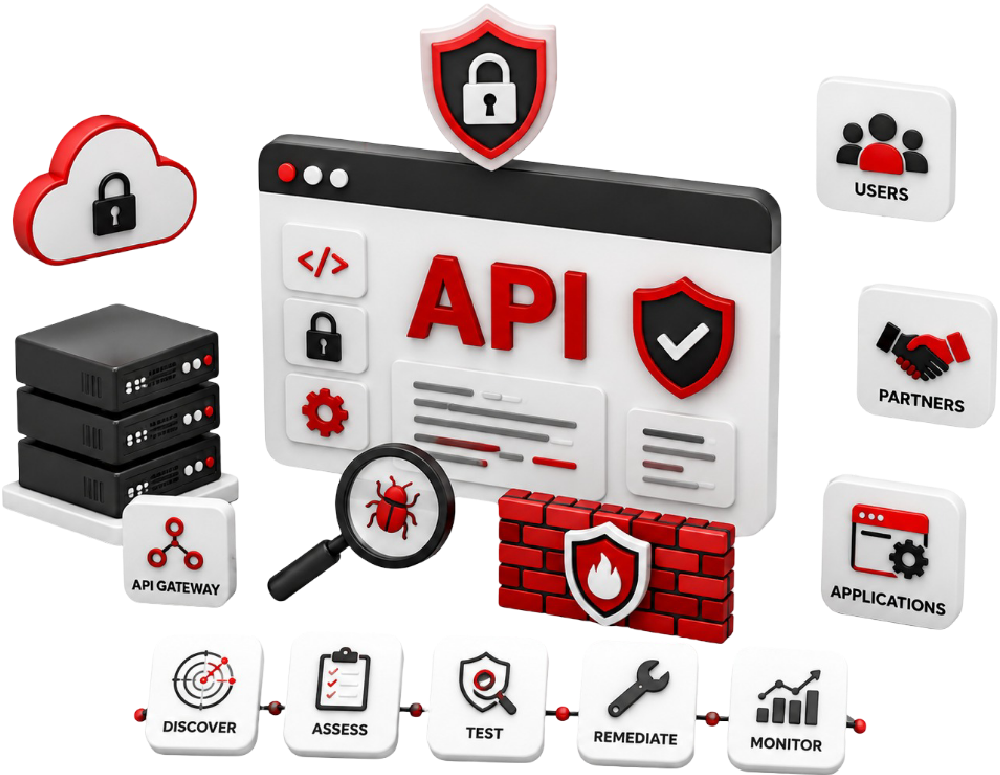
API security services protecting applications, APIs, gateways and business data in Saudi Arabia
Security from discovery to remediation Identify the API exposure, prioritize risk and turn findings into practical security actions.
API Assessment
API Testing
API Protection
API Governance
API Integration
API Management
API security assessment and protection for enterprise applications in Saudi Arabia
Application interface security

Secure the interfaces behind digital services

A public or internal API can expose sensitive data, account functions and business workflows even when the underlying application appears protected. Effective API security therefore has to consider the interface itself: who can call it, what they can access, which functions they can trigger, what data is returned, how the API is discovered and how changes are controlled.

SecureLink approaches API security around the organization's actual API estate. That can include customer-facing APIs, partner integrations, internal service-to-service APIs, mobile backends and APIs exposed through an API gateway. Our API Security Services Saudi Arabia engagements can combine assessment, testing, remediation support, governance and management depending on the required scope.

Discover known and unknown API exposure
Review authentication and authorization
Test business and technical attack paths
Prioritize remediation and ownership
Core API security services

From API discovery to controlled remediation

The right scope depends on the API estate, data sensitivity, business criticality and existing security controls. Services can be combined into a focused assessment or a broader API security improvement programme.

API Security Assessment

An API Security Assessment establishes what is exposed, how APIs authenticate and authorize callers, where sensitive data travels and which controls need attention. It gives decision-makers a practical risk picture before deeper testing or implementation begins.

  • API inventory and exposure review
  • Authentication and authorization analysis
  • Data-flow and business-impact review

API Security Testing

API Security Testing examines endpoints, parameters, methods, tokens, authorization logic and business flows for weaknesses that automated checks alone may not reveal. Testing is scoped to authorized targets and agreed test conditions.

  • Endpoint and parameter testing
  • Authorization and access-control testing
  • Business-flow and abuse-case testing

API Security Audit

An API Security Audit reviews security controls, documentation, ownership, configurations, evidence and operating practices against the agreed scope. It is useful when leadership needs an independent view of how consistently API controls are being applied.

  • Control and configuration review
  • Documentation and ownership checks
  • Action register with prioritized findings

API Penetration Testing

API Penetration Testing provides authorized adversarial testing of defined APIs to identify exploitable weaknesses and validate the effectiveness of security controls. The scope can be tailored for production-like staging environments or approved production testing windows.

  • Token and session attack paths
  • Authorization bypass scenarios
  • Business-logic abuse cases

API Vulnerability Assessment

An API Vulnerability Assessment combines discovery and technical review to identify weaknesses across API endpoints, authentication, configuration, exposure and dependencies. Findings are prioritized so teams can focus first on vulnerabilities with meaningful business impact.

  • Technical weakness identification
  • Risk ranking and remediation guidance
  • Validation of selected fixes

API Risk Assessment

API Risk Assessment connects technical findings to business context. Critical customer journeys, sensitive data, partner dependencies and privileged functions can be ranked so security investment is directed toward the APIs that matter most.

  • Business impact and exposure mapping
  • Risk-based remediation priorities
  • Executive-ready risk reporting

API Security Implementation

API Security Implementation turns agreed findings into practical controls. Depending on the environment, this can include access policies, gateway rules, authentication controls, logging, secrets handling and secure configuration changes.

  • Approved control configuration
  • Security policy and gateway changes
  • Validation and implementation handover

API Gateway Security

API Gateway Security helps protect the control point between clients and backend services. The scope can cover access policies, TLS, routing, rate controls, logging, authentication, authorization and configuration review. Where AWS API Gateway is used, the review can also consider least-privilege access, resource policies and security monitoring practices.

  • Gateway policy and exposure review
  • TLS, access and authorization controls
  • Logging, monitoring and configuration checks

Secure API Integration

Secure API Integration considers the security of connections between internal applications, partners and third-party services. Controls should account for authentication, authorization, data validation, transport protection, secrets and the risk created by trusted external APIs.

  • Third-party integration security review
  • Trust-boundary and data-flow analysis
  • Authentication and secret-management controls
API management and governance

Security needs an operating model, not only a test report

As API estates expand, organizations need a consistent way to discover, approve, secure, monitor, change and retire APIs. The following services connect security with the management lifecycle.

API Management Solutions

API Management Solutions can bring API discovery, access policies, gateway administration, documentation, monitoring and ownership into a clearer operating model. The objective is not simply more tooling; it is better visibility and consistent control across the API estate.

  • API inventory and ownership
  • Policy and access management
  • Operational visibility and reporting

API Management Platform

An API Management Platform can provide the technical foundation for publishing, securing, routing and monitoring APIs. The platform choice should follow the organization's architecture, integration model, security requirements and operational capability.

  • Gateway and policy capabilities
  • Developer and consumer access controls
  • Monitoring and lifecycle visibility

API Management Services

API Management Services can support organizations that need assistance designing operating processes, reviewing configurations, improving policies or coordinating API management with security requirements. Scope can be project-based or aligned with an ongoing operating model.

  • Management architecture review
  • Policy and configuration support
  • Operational handover and guidance

API Gateway Solutions

API Gateway Solutions can centralize routing, access control, policy enforcement and visibility between consumers and backend services. SecureLink can assess the security role of the gateway and the controls that remain necessary in the backend APIs.

  • Gateway architecture and policy review
  • Exposure and trust-boundary analysis
  • Security control consistency checks

Enterprise API Management

Enterprise API Management requires consistent ownership across many teams, applications, partners and business units. The focus is on inventory, standards, security gates, change control, lifecycle decisions and reporting that leadership can use.

  • Cross-team API ownership model
  • Security gates for new and changed APIs
  • Lifecycle and retirement governance

API Integration Platform

An API Integration Platform should not become a blind trust bridge between systems. Integration security considers authentication, authorization, data validation, transport security, secrets, third-party dependencies and monitoring so connectivity does not create unmanaged exposure.

  • Integration trust-boundary review
  • Secure authentication patterns
  • Data-flow and dependency visibility

API Governance

API Governance establishes practical rules for design, documentation, ownership, security, versioning, publication, monitoring and retirement. A governance model should be usable by development and operations teams rather than becoming a document that is disconnected from delivery.

  • Security requirements for API design
  • Ownership and exception handling
  • Change, version and retirement controls

API Lifecycle Management

API Lifecycle Management keeps security involved from discovery and design through development, release, operation, version changes and retirement. This reduces the chance that forgotten, undocumented or obsolete APIs remain exposed after their business purpose changes.

  • Design and pre-release security checks
  • Version and change management
  • Retirement and inventory cleanup
Enterprise API security

Build Enterprise API Security around real business risk

Enterprise APIs often sit across customer channels, mobile applications, partner ecosystems, internal services and cloud workloads. Security controls need to follow those trust boundaries rather than assuming every API has the same exposure or business impact.

Customer-facing APIs

Protect authentication, authorization, data exposure and high-value customer functions that are accessible through public channels.

Partner APIs

Review trust relationships, credentials, scopes, data exchange and controls for third-party integrations.

Internal APIs

Internal does not automatically mean trusted. Service-to-service access, identity and segmentation still need appropriate controls.

Mobile and application APIs

Assess the interfaces supporting mobile and web applications for authorization, session, data and business-logic weaknesses.

Visibility

Know which APIs exist, who owns them, what they expose and which environments they serve.

Control

Apply authentication, authorization, gateway and configuration controls that match the risk.

Validation

Test controls and selected remediation so teams can distinguish assumed security from verified security.

Governance

Keep security involved as APIs are created, changed, published, monitored and retired.

API risk model

What an API security review should look for

API security is not limited to checking whether a request uses HTTPS. The review should consider whether the caller is authenticated correctly, whether authorization is enforced at the right object and function level, whether sensitive data is exposed, whether resources can be abused and whether the organization actually knows which APIs are active.

SecureLink can structure testing around API-specific risks such as broken object-level authorization, broken authentication, excessive access to sensitive business flows, security misconfiguration, improper inventory management and unsafe consumption of third-party APIs. The exact test plan is adapted to the technology and authorization available for the engagement.

01

Discover and inventory

Identify endpoints, versions, environments, owners and external dependencies.

02

Authenticate and authorize

Review identity, tokens, scopes and object/function-level access decisions.

03

Validate data and business flows

Test input handling, data exposure, sensitive functions and abuse scenarios.

04

Protect the gateway and transport

Review TLS, gateway policies, routing, rate controls and exposure.

05

Monitor and govern

Maintain logging, ownership, lifecycle controls, exceptions and remediation tracking.

Control area What we examine Business value
Authentication Tokens, credentials, session handling and authentication flows. Reduces the risk of unauthorized API access and account compromise.
Authorization Object-level, function-level and role-based access decisions. Helps prevent users or systems accessing data or functions beyond their intended scope.
Data exposure Response content, sensitive fields, excessive data and error handling. Limits unnecessary disclosure of business and customer information.
Business logic High-value workflows, transaction sequences and abuse cases. Tests whether legitimate functions can be manipulated in unintended ways.
Inventory Known, undocumented, deprecated and externally reachable APIs. Improves visibility and reduces forgotten attack surface.
Gateway and transport TLS, policies, routing, exposure, logging and access controls. Strengthens the control layer between API consumers and backend services.
Conversion-ready engagement options

Start with the API security problem you need to solve

You do not need to begin with a large security programme. SecureLink can scope the first engagement around the immediate business question, then identify the next priority after the findings are understood. This makes the work easier to approve internally and gives technical teams a clear path from discovery to action.

We need to know whether our APIs are exposed

Start with API discovery, inventory, exposure analysis and an API Security Assessment to establish the current risk picture.

START WITH ASSESSMENT →

We need independent testing

Use API Security Testing, API Vulnerability Assessment or API Penetration Testing for authorized targets and agreed test conditions.

REQUEST TESTING →

We have findings but need implementation

Translate prioritized findings into API Security Implementation work covering approved gateway, access, logging and configuration controls.

DISCUSS REMEDIATION →

Our API estate is growing too quickly

Use API Governance, API Lifecycle Management and API Management Services to introduce clearer ownership, security gates and lifecycle controls.

BUILD THE MODEL →
Delivery approach

A practical API security process from scope to validation

Security testing and implementation are planned around authorization, technical dependencies, business-critical flows and the operating environment. The objective is useful evidence and clear next actions, not a long report with no owner.

01

Scope

Confirm APIs, environments, owners, credentials, exclusions and business-critical functions.

02

Discover

Map endpoints, versions, authentication paths, gateways, dependencies and exposure.

03

Assess and test

Review controls and test authorized technical and business-logic attack paths.

04

Prioritize

Translate findings into business risk, technical severity, ownership and remediation priority.

05

Validate and govern

Validate selected fixes and establish the governance or lifecycle controls needed to sustain them.

High-intent API security use cases

When organizations typically contact an API security consultant

API security becomes urgent when a new integration, product launch, audit requirement or security concern changes the exposure of the digital estate.

New API or digital product launch

Review security requirements before a customer-facing API becomes a large and difficult-to-change production dependency.

Partner integration

Assess trust boundaries, authentication, data exchange and authorization before exposing business services to a third party.

Security or compliance review

Produce technical evidence and a prioritized API security action plan that can feed into the wider security and governance programme.

Suspected API weakness

Investigate unexpected access, exposed endpoints, unusual traffic or concerns about authorization and data exposure.

Growing API estate

Introduce API Governance, inventory, ownership and API Lifecycle Management before undocumented APIs become an operational problem.

Post-test remediation

Move from findings to implementation, validation and ongoing control ownership instead of treating the test report as the final step.

Why SecureLink

API security that connects technical findings to business action

The value of an API security engagement is not only the number of findings. It is whether the organization can understand the exposure, decide what matters, assign ownership and keep the resulting controls effective as APIs change.

Security-first scope

Assessment and testing are structured around authentication, authorization, exposure, business logic, gateway controls and lifecycle risk.

Actionable reporting

Findings are written so technical teams and decision-makers can understand impact, priority, ownership and the next action.

Saudi business context

API security can be coordinated with the wider cybersecurity, privacy, risk and regulatory requirements relevant to Saudi organizations.

Technology-aware approach

The scope can account for gateways, identity systems, cloud services, application architecture and third-party integrations rather than testing an API in isolation.

Governance beyond one test

Where required, the engagement can extend into API Governance, API Lifecycle Management and API Management Services.

Clear handover

Client teams receive practical findings, priorities and agreed next steps instead of being left with a report that has no implementation path.

Frequently asked questions

API security questions from Saudi organizations

The right scope depends on the APIs, environments, data, business functions and authorization available for testing. A short discovery discussion can establish whether an assessment, test, implementation or governance engagement is the best starting point.

Talk to an API Security Consultant
What is API security and why does it matter for Saudi organizations?
API security protects the interfaces that allow applications, partners, employees and customers to exchange data and trigger business functions. A practical programme reviews authentication, authorization, input handling, exposure, inventory, gateway controls, logging and business-flow risks rather than treating an API as only a development concern.
What is included in an API Security Assessment?
An API Security Assessment can include API discovery, inventory review, authentication and authorization checks, endpoint exposure analysis, configuration review, business-logic testing, data-flow analysis, gateway controls and prioritized remediation recommendations.
How is API Security Testing different from a normal penetration test?
API Security Testing is focused specifically on API endpoints, methods, parameters, tokens, authorization logic, business flows and API-specific attack paths. A broader penetration test may include APIs as one part of a wider application, network or infrastructure scope.
Does SecureLink provide API Penetration Testing?
API Penetration Testing can be scoped for authorized APIs and defined environments. Testing should be agreed in advance around targets, credentials, test windows, exclusions, rate limits and reporting requirements to avoid disruption to production services.
Can you assess APIs behind an API gateway?
Yes. API Gateway Security should be reviewed together with the APIs behind the gateway. The assessment can consider authentication, authorization, TLS, routing, rate controls, logging, exposure, policy configuration and whether gateway controls are consistent with backend security.
Can API security support compliance requirements?
API security controls can contribute technical evidence and risk reduction for applicable governance and compliance programmes. The exact requirements depend on the organization, data, systems and applicable regulatory framework, so API security should be mapped to the wider security and compliance programme rather than presented as a standalone compliance guarantee.
Do you help with API remediation after testing?
Yes. Where remediation is included in the agreed scope, SecureLink can help translate findings into prioritized fixes, configuration changes, access-control improvements, gateway policy changes and validation activities. Development teams retain ownership of application code changes unless a separate implementation scope is agreed.
What is API Governance?
API Governance establishes practical rules for how APIs are designed, documented, secured, published, changed, monitored and retired. It helps organizations maintain visibility and consistent controls as the API estate grows across teams and platforms.
Can SecureLink help with API management as well as security?
Yes, where the engagement requires it. API Management Services can address inventory, lifecycle processes, gateway policies, access, documentation, ownership and operational controls while keeping security requirements integrated into the management model.
What should we prepare before requesting an API security engagement?
Useful information includes API documentation such as OpenAPI definitions where available, gateway details, authentication methods, environments, test credentials, known APIs, business-critical flows, third-party integrations, data classifications and the preferred testing window.
How long does an API security engagement take?
The timeline depends on the number of APIs, endpoints, authentication models, environments, business flows and depth of testing. A focused assessment can be scoped separately from a larger programme covering discovery, testing, remediation, governance and ongoing API management.
Can you assess APIs used by enterprise applications and third parties?
Yes. Enterprise API Security should account for internal APIs, partner integrations, customer-facing APIs and third-party dependencies. The exact testing approach is adjusted for authorization boundaries, data sensitivity, business impact and contractual testing permissions.

Find the API risks that matter before they become business problems

Share the API environment you need reviewed, the business functions it supports and the immediate concern you want answered. SecureLink can scope an API Security Assessment, API Security Testing, API Penetration Testing, API Security Implementation or an API governance programme around your actual requirements.